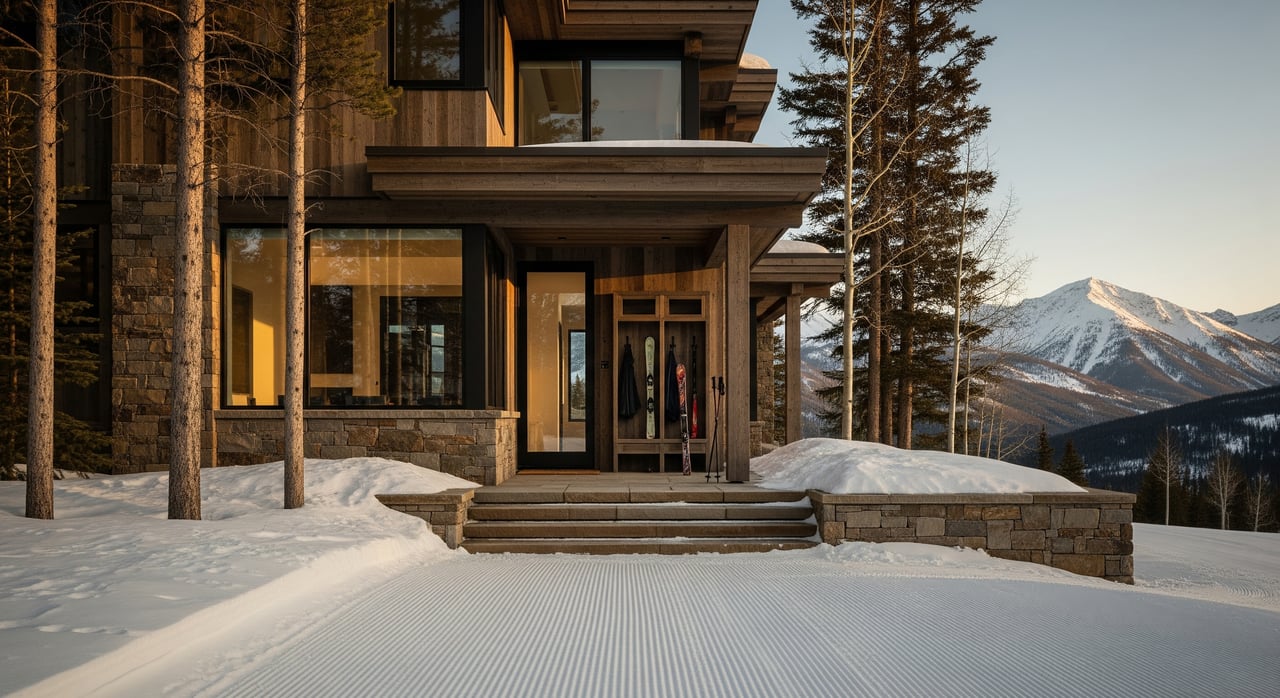
Does ski-in/ski-out mean you click in on your patio or walk six minutes in ski boots down icy stairs? In Big Sky, the difference can change your day and your property’s value. If you want true slope convenience, you need clear definitions and on-the-ground ways to verify what a listing really offers. In this guide, you will learn the access tiers, how Big Sky and Moonlight Basin layout affects them, and a practical checklist to confirm the route before you buy. Let’s dive in.
Big Sky layout: why the lift pod matters
Big Sky stretches across multiple ridges with distinct lift pods and base areas. Neighborhoods sit beside different parts of the mountain, and access varies from one pod to the next. Being “near the mountain” is not enough. You need to know which lift a property uses and how you get there.
Moonlight Basin shares skiable terrain with parts of Big Sky’s network and includes its own lodges and residential areas. Some homes sit right beside groomed runs. Others rest on ridgelines or meadows and use short connectors or community shuttles. The exact lift connection, the pitch of the route, and seasonal grooming all matter.
Clear tiers of ski access
True ski-in/ski-out
- Practical definition: You can put on skis or keep them on at the property and directly reach a groomed run, lift, or marked trail without walking more than a few steps, bootpacking, taking a shuttle, or crossing a public road.
- Objective signs: A groomed or marked run adjacent to the property, a maintained ski accessway from the building to the trail, and a recorded ski easement in the deed or HOA documents.
- Distance guide: 0 to 50 feet for immediate ski-out.
- Buyer notes: Expect premium pricing and limited supply. Winter maintenance, snow shedding from roofs, garage access, and resort avalanche control practices near the structure are important.
Ski-accessible
- Practical definition: You ski a short distance on a gentle connector or traverse to reach the nearest lift or run. In low snow, you might need minor pole pushing or a brief bootpack.
- Objective signs: The property is very close to a run, but the route includes a short connector, crossing a path, or travel on an HOA trail.
- Distance guide: About 50 to 400 feet or a 0 to 2 minute ski or traverse. In marginal snow, a short walk may be necessary.
- Buyer notes: Convenient for many intermediate and advanced skiers. Verify connector grooming and how it performs early and late season.
Walk-to-lift
- Practical definition: You walk a short distance, commonly 2 to 10 minutes, to a lift, gondola, tram, or groomed run access. The route may include stairs, boardwalks, or plowed roads.
- Objective signs: Distance typically 0.1 to 0.5 miles when marketed as walkable. Pedestrian routes should be measured and verified, including elevation change and surfaces.
- Distance guide: 0.1 to 0.5 miles or 2 to 10 minutes on foot.
- Buyer notes: A good compromise. Consider mobility, carrying gear, winter sidewalk maintenance, and whether the route is uphill or downhill.
Shuttle or drive required
- Practical definition: You must use a community or resort shuttle, private vehicle, or taxi to reach the lifts. It is not practical to ski directly from the property.
- Objective signs: The route is separated from terrain by roads, parking, or distance beyond a comfortable walk or ski. Neighborhoods may provide scheduled shuttles.
- Distance guide: Greater than 0.5 miles or routes that require crossing roads or parking areas.
- Buyer notes: Typically more affordable. Verify shuttle frequency, holiday surge capacity, and if the service operates during storms and shoulder seasons.
Big Sky and Moonlight nuances that change access
- Which lift matters: A home can be “on the mountain” yet connect to a pod with limited grooming or seasonal hours. Confirm which lift is closest and if the approach is downhill, flat, or uphill.
- Roads and crossings: If you must cross a road, parking lot, or pass outside a resort boundary, that usually breaks the standard for true ski-in/ski-out.
- Private communities and HOAs: Moonlight Basin and nearby neighborhoods may control shuttle access, ski paths, and easements. HOA rules can govern snow removal, walkway clearing, and who maintains ski connectors.
- Snow variability: Big Sky’s climate typically provides deep mid-season snow, but wind scouring, freeze-thaw, and low-snow years can thin flat connectors. Snowmaking and grooming priorities near a property affect reliability.
- Avalanche control and safety: Some homes sit near steeper terrain. Confirm who is responsible for avalanche mitigation in adjacent zones and whether your route lies within controlled areas.
- Resort operations: Lift schedules, grooming plans, and seasonal closures evolve. Rely on current trail maps and operational notices rather than historical claims in a listing.
Real-world scenarios in Big Sky
Example A: Front-door drop to a groomed run
- Scenario: A patio or yard opens directly onto a groomed run with signage or a designated corridor from the building to the trail. No roads or lots to cross.
- Classification: True ski-in/ski-out.
- Buyer tip: Ask for recorded ski easements and HOA maintenance language that protects the corridor. Get documentation.
Example B: Short connector across a meadow
- Scenario: The home sits 100 to 300 feet from a marked run via a gentle meadow traverse.
- Classification: Ski-accessible.
- Buyer tip: Confirm whether the resort or HOA grooms or marks the connector and how it holds up in early and late season.
Example C: Walk to a pod lift via stairs
- Scenario: A condo marketed as walk-to-lift with three flights of exterior stairs and a paved path of about six minutes to the nearest base.
- Classification: Walk-to-lift.
- Buyer tip: Evaluate winter maintenance, handrails, lighting, and whether narrow steps make it hard to carry skis.
Example D: HOA shuttle to base area
- Scenario: A neighborhood without direct piste connections that relies on a scheduled HOA shuttle every 20 to 30 minutes.
- Classification: Shuttle or drive required.
- Buyer tip: Review holiday schedules, storm protocols, and whether shuttle costs are included in HOA fees.
Note: Always verify specific routes against the current resort trail map, recorded easements, and your HOA’s rules. Operations and policies can change.
How to verify a property’s ski access
On the property and listing
- Request a property-level route map showing the exact path to the nearest lift or run, with distances and elevation change.
- Obtain deed, plat, or HOA documents that describe ski easements, rights of way, and who maintains connector trails.
- Confirm parcel boundaries and whether the route crosses neighboring private land with proper agreements.
With the resort and mountain operations
- Identify which lift or pod serves the route and whether it is typically open during your intended visits.
- Ask if the connector and nearby run are part of regular grooming and whether snowmaking supports them.
- Confirm if the route lies within controlled avalanche zones and who performs mitigation.
With HOA or community management
- Review shuttle schedules, accessibility policies, and winter road and sidewalk maintenance.
- Check any restrictions on ski storage, use of exterior stairs, or private snowblowers.
- Request maintenance records for stairs, boardwalks, and any incident logs related to winter access.
On-site verification
- Visit in early and late season to see how the route functions in marginal snow.
- Walk or bootpack the full route with gear, time it, and note stairs, crossings, narrow spots, and steep sections.
Insurance and safety
- Ask your insurer about liability related to ski access and whether avalanche or collision claims are excluded.
- Inquire about any past remediation or avalanche incidents near the property.
What this means for price and resale
- Price premium: Documented doorstep ski access usually commands a premium over shuttle or drive properties. The scale depends on supply, demand, and the specific lift pod.
- Liquidity and resale: True ski-in/ski-out is scarce and often more sought after. If rentals are allowed, seasonal demand can be strong. Confirm HOA restrictions.
- Operating costs: Doorstep access can increase winter upkeep, including snow clearing, roof loads, and potential special assessments related to access corridors.
Next steps for Big Sky buyers
- Decide which lift pod you want to use most and how you prefer to reach it.
- Use the tier definitions and distance guides to filter listings.
- Ask for route maps, recorded easements, grooming details, and shuttle schedules before you tour.
- Verify on site in different conditions and time the route with gear.
When you are ready for tailored guidance on Big Sky and Moonlight Basin access, schedule a conversation with Michelle Horning. You will get local insight, careful documentation review, and a plan that fits how you actually ski.
FAQs
What does true ski-in/ski-out mean in Big Sky?
- You can put on or keep skis on at the property and reach a groomed run or lift without walking more than a few steps, shuttling, or crossing roads.
How far is walk-to-lift in Big Sky terms?
- Typically 0.1 to 0.5 miles, or about 2 to 10 minutes on foot, including stairs or boardwalks that should be verified and timed.
Is Moonlight Basin mostly ski-in/ski-out?
- It varies by neighborhood and elevation; some homes are true doorstep access while others rely on short connectors or community shuttles.
How reliable is access in early or late season?
- Flat connectors can thin out in low snow, so you may need to pole or walk; snowmaking and grooming near the route increase reliability.
What should I ask a listing agent about ski access?
- Request a map of the exact route, recorded easements, grooming responsibility, shuttle details, and whether any roads or parking must be crossed.
Does crossing a road still count as ski-in/ski-out?
- No, crossing roads or parking areas usually breaks the standard for true ski-in/ski-out and moves a property into another tier.